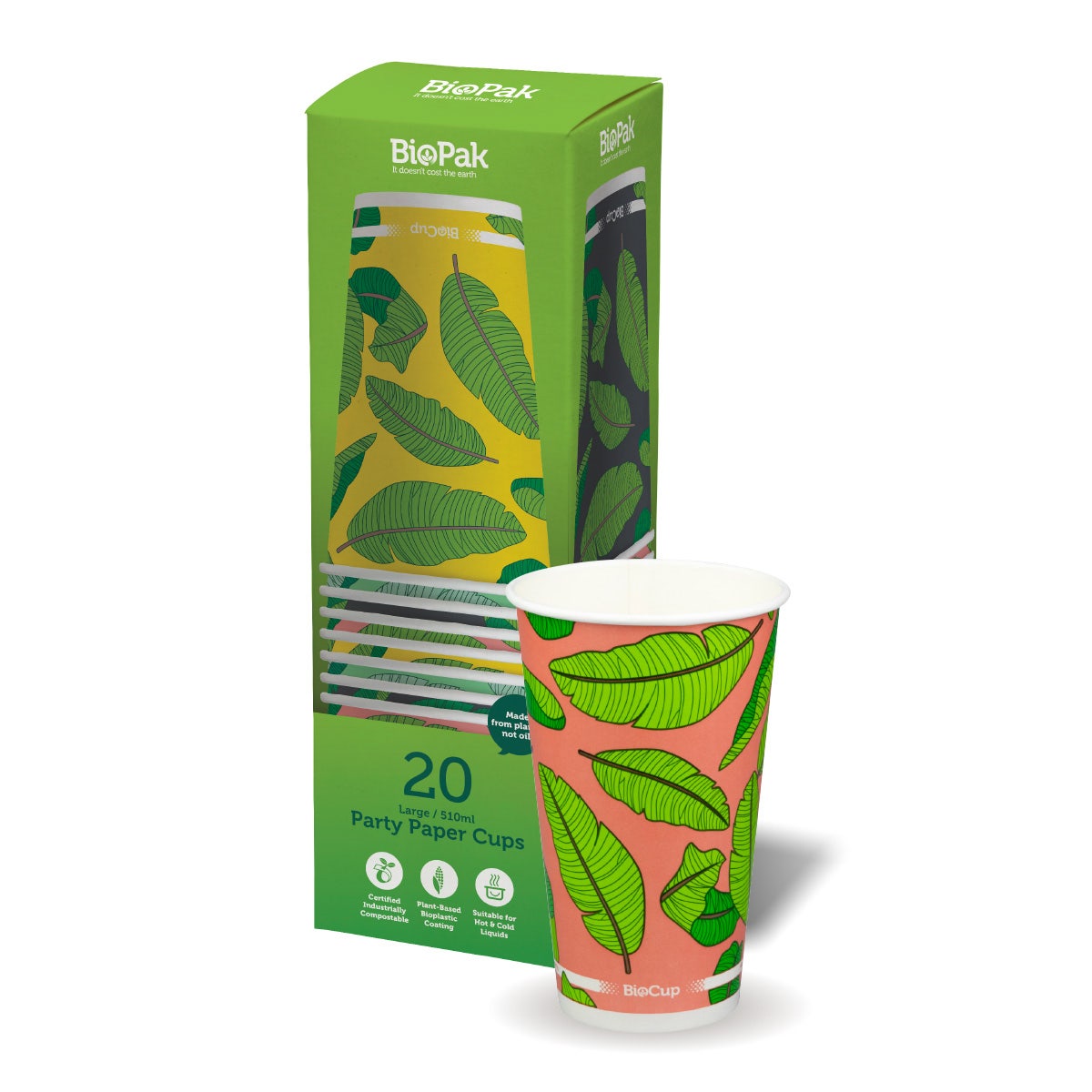
Description 16oz paper cold cups are lined inside and out with Ingeoâ„¢, a bioplastic made from plants, not oil – making them the perfect option for cold drinks. BioCups are certified industrially compostable. These cold drink cups are packaged for retail sale and are shelf-ready. Each retail box contains 20 party cups and a carton contains 5 boxes. Product specifications Download specs (PDF) Download specs (CSV) Ordering & logistics Product dimensions Materials & production Certifications Compost & recycling Sustainability Carton quantity 100 Sleeves per carton 5 Units per sleeve 20 Carton Size LxWxH (cm) 49.5x10.5x31.5 Carton gross weight (kg) 1.520000 Dimensions base LxW (mm) 58x58 Product Depth 137 Product weight (g) 9.15 Thickness 263gsm Use Hot and cold Raw Material Paper - FSC™ Mix certified paper Lining/coating Bioplastic - PLA Inks Food Contact Safe Inks Environmental production certified ISO 14001 Facility Quality Systems ISO 9001 Factory food safety certified BRC Home compostable No Industrially compostable Certified to AS4736 Australian Standards, Certified to EN13432 European Standard Recyclable Not Recyclable BioPak material Aqueous Material breakdown Paper - FSC™ Mix certified paper — Bioplastic - PLA lining/coating End of life Industrial composting (AS 4736) Infrastructure note PLA items require industrial composting (AS 4736) or general waste where no facility exists. Certifications Industrially compostable: Certified to AS4736 Australian Standards, Certified to EN13432 European Standard · Environmental production certified: ISO 14001 · Factory food safety certified: BRC · FSC (material) Carbon data Product weight 9.15g per unit (BioPak specification). Manufactured under ISO 14001 Product weight 9.15 g per unit Packaging tools Check plastic ban status, measure impact, generate disposal QR codes, and right-size orders — without leaving this page. Disposal QR Impact Right-size Plastic bans Username or Email Address Password Remember Me Or Login Via Magic URL Enter the email address or username associated with your account, and we'll send a magic link to your inbox. Your Email/Username Continue Or Use Regular Login form Not registered? Create an AccountForgot your password? Reset PasswordFirst NameLast NameUsernameEmail AddressPassword SignupAlready have an account? LoginEmail Address Reset Password For this product 20 Pack – 16oz Cold Paper BioCup Material Paper - FSC™ Mix certified paper — Bioplastic - PLA lining/coating PFAS Not applicable PFAS is not relevant to this packaging material. Home compostable No Industrial compostable Certified to AS4736 Australian Standards, Certified to EN13432 European Standard Recyclable Not Recyclable Recommended disposal Industrial composting (AS 4736) How to dispose PLA items require industrial composting (AS 4736) or general waste where no facility exists. General Aqueous pathways from BioPak are shown below for reference. Council guidance (example postcode) Perth metro. Banned items include plastic straws, cutlery, plates, polystyrene food containers and thick plastic bags. Phase 2 expansion underway. Lids, cutlery & other: Lids, sleeves, cutlery and accessories: check material. CPLA and wooden items are often general waste. Material Bin / stream Note Paper & cardboard Recycling bin Clean paper and cardboard only. Rigid plastic Recycling bin Rigid containers if accepted by your council. Soft plastic Store drop-off or landfill Soft plastics generally not kerbside recyclable. Certified compostable (AS 4736) Commercial composting Perth councils differ on FOGO and compostable packaging. Home compostable (AS 5810) Home compost or landfill Home compost if AS 5810 certified. Soiled or mixed materials Landfill Banned single-use plastics and soiled packaging. Disposal guidance is general information only. Always check your local council rules. BioPak material pathways Plant Fibre Industrial Composting Home Composting Recycling Industrial Composting Some councils offer residential Food Organics and Green Organics (FOGO) collections that accept compostable packaging. Please check with your council or visit Compost Connect to find a business near you that uses a compost service. Our BioCane plant fibre packaging with no added PFAS can be composted in industrial facilities. Compost Certifications Products like our Plant Fibre BioCup Lid and Plant Fibre Cutlery with no added PFAS are industrially compostable to Australian AS4736 and European EN13432 standards. Check each individual product for specific details. AS4736 certified ABAP 10063 EN13432 certified 7P0660 Home Composting Our BioCane plant fibre packaging with no added PFAS is certified home compostable. They can be composted in your backyard compost. Compost Certifications Products like our Plant Fibre BioCup Lid and Plant Fibre Cutlery with no added PFAS are home compostable to Australian (AS5810) and European (NF T51-800) standards. Check each individual product for specific details. AS5810 Certified ABAP 20008 NF T51-800 Certified 9P0005 Recycling Recyclability is verified by the Packaging Evaluation Portal (PREP) – an independent tool run by the Australian Packaging Covenant (APCO) that verifies what packaging is or isn't recyclable in Australia and New Zealand. BioPak's plant fibre packaging is suitable for recycling along with cardboard, as long as it's clean and no food residue remains. Recycling is a good end-of-life solution for our produce trays. Check with your local council to find out more and stay updated with the latest recycling information. PLA-Lined Paper Industrial Composting Home Composting Recycling Industrial Composting Some councils offer residential Food Organics and Green Organics (FOGO) collections that accept compostable packaging. Please check with your council or visit Compost Connect to find a business near you that uses a compost service. If you're a business, you can join Compost Connect, a not-for-profit composting initiative connecting foodservice businesses to commercial organic waste pick-up services. PLA lined paper cups and boxes can be composted in industrial facilities. Compost Certifications Our Paper BioCups and BioBoard range are certified industrially compostable to Australian AS4736 and European EN13432 standards. AS4736 certified ABAP 10256 EN13432 certified 7P0776 Home Composting The PLA bioplastic lining that we use for our paper cups and boxes is not certified home compostable as it does not biodegrade in home compost conditions within the testing timeframe. We have documented these cups successfully compost in a home compost simulation, however, as conditions are variable a certification cannot be issued. If you're looking for a certified home compostable coffee cup solution, discover our aqueous-lined cups! Recycling We've marked them here as not recyclable in alignment with the Packaging Evaluation Portal (PREP) – an independent tool run by the Australian Packaging Covenant (APCO) that verifies what packaging is or isn't recyclable in Australia and New Zealand. Paper lined with either PLA bioplastic or PE plastic is not accepted in most mixed or paper recycling streams. Some facilities can recycle them, so always check with your local council for the latest information. Aqueous Industrial Composting Home Composting Recycling Industrial Composting Some councils offer residential Food Organics and Green Organics (FOGO) collections that accept compostable packaging. Please check with your council or visit Compost Connect to find a business near you that uses a compost service. If you're a business, you can join Compost Connect, a not-for-profit composting initiative connecting foodservice businesses to commercial organic waste pick-up services. Aqueous-lined paper cups can be composted in industrial facilities. Compost Certifications Aqueous lined paper cups are certified industrially compostable to European EN13432 standards, and will soon be certified industrially compostable to Australian AS4736 standards. EN13432 Certified 9G0234 Home Composting Our aqueous-lined biocups are certified home compostable to Australian (AS5810) and European (NF T51-800) standards. These cups are food safe, odourless, and can be disposed of right in your backyard compost bin! Compost Certifications AS5810 Certified ABAP 20176, ABAP 20177 NF T51-800 Certified 9P0092, 9P0093 Recycling We've marked them here as not recyclable in alignment with the Packaging Evaluation Portal (PREP) – an independent tool run by the Australian Packaging Covenant (APCO) that verifies what packaging is or isn't recyclable in Australia and New Zealand. No aqueous-lined paper cups are accepted in the paper mixed recycling stream and they could potentially contaminate the clean paper recycling stream. Their best end-of-life solution is through industrial composting. PHA Lining Industrial Composting Home Composting Recycling Industrial Composting Some councils offer residential Food Organics and Green Organics (FOGO) collections that accept compostable packaging. Please check with your council or visit Compost Connect to find a business near you that uses a compost service. If you're a business, you can join Compost Connect, a not-for-profit composting initiative connecting foodservice businesses to commercial organic waste pick-up services. PHA-lined paper cups can be composted in industrial facilities. Compost Certifications PHA-lined cups are certified industrially compostable to Australian AS4736 and European EN13432 standards where marked on the SKU. AS4736 Certified Per product certification EN13432 Certified Per product certification Home Composting PHA-lined cups are certified home compostable to Australian (AS5810) and European (NF T51-800) standards where marked on the SKU. Compost Certifications AS5810 Certified Per product certification NF T51-800 Certified Per product certification Recycling We've marked them here as not recyclable in alignment with the Packaging Evaluation Portal (PREP) – an independent tool run by the Australian Packaging Covenant (APCO) that verifies what packaging is or isn't recyclable in Australia and New Zealand. PHA-lined paper cups are not accepted in the paper mixed recycling stream. Their best end-of-life solution is through composting. FSC™ Paper and Birchwood Industrial Composting Home Composting Recycling Industrial Composting Some councils offer residential Food Organics and Green Organics (FOGO) collections that accept compostable packaging. Please check with your council or visit Compost Connect to find a business near you that uses a compost service. If you're a business, you can join Compost Connect, a not-for-profit composting initiative connecting foodservice businesses to commercial organic waste pick-up services. Paper and cardboard are considered processed fibrous organics and fit within the EPA's organics category 1 which is suitable for compost feedstock. The Environmental Protection Authority (EPA) is the primary environmental regulator in Australia and protects the community and our environment. Our 100% paper products can be composted in industrial facilities. Home Composting They're a source of carbon which can help maintain the carbon-nitrogen balance of your compost pile. 100% paper products can be composted in your home compost. Recycling Recyclability is verified by the Packaging Evaluation Portal (PREP) – an independent tool run by the Australian Packaging Covenant (APCO) that verifies what packaging is or isn't recyclable in Australia and New Zealand. 100% paper is recyclable in the paper recycling stream. However, it needs to be fairly clean, which is not always the case with food packaging. Unlined BioBoard, paper bags and straws are accepted in the recycling stream, but not napkins. Recyclable in kerbside paper and mixed collections (PREP) Paper (non-FSC) Industrial Composting Home Composting Recycling Industrial Composting Some councils offer residential Food Organics and Green Organics (FOGO) collections that accept compostable packaging. Please check with your council or visit Compost Connect to find a business near you that uses a compost service. If you're a business, you can join Compost Connect, a not-for-profit composting initiative connecting foodservice businesses to commercial organic waste pick-up services. Paper and cardboard are considered processed fibrous organics and fit within the EPA's organics category 1 which is suitable for compost feedstock. The Environmental Protection Authority (EPA) is the primary environmental regulator in Australia and protects the community and our environment. Uncertified paper products can be composted in industrial facilities where accepted. Home Composting They're a source of carbon which can help maintain the carbon-nitrogen balance of your compost pile. Paper products can be composted in your home compost where accepted. Recycling Recyclability is verified by the Packaging Evaluation Portal (PREP) – an independent tool run by the Australian Packaging Covenant (APCO) that verifies what packaging is or isn't recyclable in Australia and New Zealand. Paper is recyclable in the paper recycling stream when clean and dry. Food-soiled packaging may need general waste u2014 check local rules. Recyclable in kerbside paper and mixed collections (PREP) Wood & Bamboo Industrial Composting Home Composting Recycling Industrial Composting Some councils offer residential Food Organics and Green Organics (FOGO) collections that accept compostable packaging. Please check with your council or visit Compost Connect to find a business near you that uses a compost service. If you're a business, you can join Compost Connect, a not-for-profit composting initiative connecting foodservice businesses to commercial organic waste pick-up services. Wood packaging is considered untreated timber and fits within the EPA's organics category 1 which is suitable for compost feedstock. The Environmental Protection Authority (EPA) is the primary environmental regulator in Australia and protects the community and our environment. Our wood products can be composted in industrial facilities. Home Composting They're a source of carbon which can help maintain the carbon-nitrogen balance of your compost pile. BioPak's wooden cutlery can be composted in your backyard compost.nnOur wooden cutlery is made from FSCu2122 certified birchwood, and our coated range has been coated with a food-safe, non-toxic, compostable plant-based carnauba wax. Recycling We've marked them here as not recyclable in alignment with the Packaging Evaluation Portal (PREP) – an independent tool run by the Australian Packaging Covenant (APCO) that verifies what packaging is or isn't recyclable in Australia and New Zealand. Wood products are not accepted in mixed or paper recycling streams. The best end-of-life solution is composting. PLA Bioplastic Industrial Composting Home Composting Recycling Industrial Composting Some councils offer residential Food Organics and Green Organics (FOGO) collections that accept compostable packaging. Please check with your council or visit Compost Connect to find a business near you that uses a compost service. If you're a business, you can join Compost Connect, a not-for-profit composting initiative connecting foodservice businesses to commercial organic waste pick-up services. Clear PLA products and PLA hot cup lids can be composted in industrial facilities. Compost Certifications Clear PLA products and PLA hot cup lids are certified industrially compostable to Australian AS4736 and European EN13432 standards. AS4736 Certified ABAP 10061 (cup lids), ABAP 10058 (clear PLA) EN13432 7P1150 (cup lids), 7P1151 (clear PLA) Home Composting PLA bioplastic in clear cups, clear lids and hot cup lids is not certified home compostable — it does not biodegrade in home compost conditions within the testing time frame. Recycling We've marked them here as not recyclable in alignment with the Packaging Evaluation Portal (PREP) – an independent tool run by the Australian Packaging Covenant (APCO) that verifies what packaging is or isn't recyclable in Australia and New Zealand. PLA products are not accepted in the mixed recycling stream. While PLA is technically recyclable, large-scale infrastructure to process it (material category 7) is not well established. The best end-of-life solution is commercial composting. PLA Film & Bags Industrial Composting Home Composting Recycling Industrial Composting Some councils offer residential Food Organics and Green Organics (FOGO) collections that accept compostable packaging. Please check with your council or visit Compost Connect to find a business near you that uses a compost service. If you're a business, you can join Compost Connect, a not-for-profit composting initiative connecting foodservice businesses to commercial organic waste pick-up services. PLA film, bags and gloves can be composted in industrial facilities. Compost Certifications PLA film and bag products are certified industrially compostable to Australian AS4736 standards. AS4736 Certified ABAP 10022 Home Composting PLA film, bags and gloves can biodegrade in home compost conditions within the home certification testing time frame. Compost Certifications PLA bags, gloves and film for sleeves are certified home compostable to Australian AS5810 standards. AS5810 Certified ABAP 20005 Recycling We've marked them here as not recyclable in alignment with the Packaging Evaluation Portal (PREP) – an independent tool run by the Australian Packaging Covenant (APCO) that verifies what packaging is or isn't recyclable in Australia and New Zealand. PLA film and bag products are not accepted in the mixed recycling stream. The best end-of-life solution is composting. Fossil Plastic Industrial Composting Home Composting Recycling Industrial Composting Where compostable plant-based lids are not as functional, still very expensive, or the raw material is in short supply, we offer a very limited range of plastic alternatives. These will be phased out by 2025. At BioPak, we're always looking for better and more innovative replacements. All of our fossil-based plastic products are well-marked and not compostable. Home Composting Where compostable plant-based lids are not as functional, still very expensive, or the raw material is in short supply, we offer a very limited range of plastic alternatives. These will be phased out by 2025. At BioPak, we're always looking for better and more innovative replacements. All of our fossil-based plastic products are well-marked and not compostable. Recycling Take note, plastic should not be contaminated with food and black lids are currently not accepted in the recycling stream. In many cases, our fossil-based plastic lids are recyclable in alignment with the Packaging Evaluation Portal (PREP) u2013 an independent tool run by the Australian Packaging Covenant (APCO) that verifies what packaging is or isn't recyclable in Australia and New Zealand. Recyclable in kerbside paper and mixed collections (PREP) Log in to generate a Disposal QR code for your venue's postcode. BioPak specification: 20 Pack – 16oz Cold Paper BioCup (RT-BCC-16-5X20P-P) — 9.15g per unit. Weekly units Weeks per year Calculate impact Download impact data (PDF) Download impact data (CSV) Model your full packaging range → Match serve size to the right cup or container to cut waste and freight costs. Serve type Hot coffee / tea Cold drink Meal / takeaway Serve volume (ml, optional) Food moisture (meals only) Mostly dry Saucy / wet Get recommendation Open full right-size recommender → Plastic ban status for 20 Pack – 16oz Cold Paper BioCup Enter your Australian postcode to see whether this product is affected by single-use plastic rules where you operate. Assessment uses BioPak material: Aqueous Your postcode Update Compare all states & territories ACT Australian Capital Territory Compliant Aqueous-coated paperboard is not listed in ACT single-use plastic bans for food service ware. NSW New South Wales Compliant Paperboard with aqueous coating is generally outside NSW lightweight plastic bans when no conventional plastic lining is used. NT Northern Territory Check locally NT rules evolve — verify current exemptions for aqueous-coated board. QLD Queensland Compliant Queensland bans target specific plastic items; aqueous-coated fibre board is typically permitted. SA South Australia Compliant South Australia restrictions focus on conventional plastics and specific banned items, not aqueous-coated paper. TAS Tasmania Check locally Tasmania is phasing in bans — confirm aqueous-coated board status for your SKU. VIC Victoria Compliant Victorian bans target specific single-use plastics; aqueous-coated paperboard is generally permitted. WA Western Australia Compliant Western Australia bans specific plastic items; aqueous-coated fibre products are typically allowed. Guidance only. Rules change — confirm with your state environment agency before relying on this for compliance decisions. Learn about current & future plastic bans More packaging tools → Compliant alternatives Products BioPak suggests when this item is restricted in your state. Hot friendly Cold friendly Dry contents 25 Pack – 12oz Cold Paper BioCup $28.25 GST Per carton of 125 ($0.226/unit) Hot friendly Cold friendly AS 4736 25 Pack – 295ml / 8oz (90mm) Art Series Single Wall BioCup $28.60 GST Per carton of 150 ($0.191/unit) Hot friendly Cold friendly AS 4736 16 Pack – 390ml / 12oz Double Wall BioCup & Paper Lid $27.90 GST Per carton of 48 ($0.581/unit) Hot friendly Cold friendly Dry contents 25 Pack – 295ml / 8oz (80mm) Art Series Single Wall BioCup $23.35 GST Per carton of 100 ($0.234/unit) Related products Often purchased together with this item. Hot friendly Cold friendly Dry contents 25 Pack – 12oz Cold Paper BioCup $28.25 GST Per carton of 125 ($0.226/unit) Hot friendly Cold friendly Dry contents 25 Pack – 295ml / 8oz (80mm) Art Series Single Wall BioCup $23.35 GST Per carton of 100 ($0.234/unit) Hot friendly Cold friendly AS 4736 16 Pack – 390ml / 12oz Double Wall BioCup & Paper Lid $27.90 GST Per carton of 48 ($0.581/unit) Hot friendly Cold friendly AS 4736 25 Pack – 295ml / 8oz (90mm) Art Series Single Wall BioCup $28.60 GST Per carton of 150 ($0.191/unit)
Brand
Envirochoice
Related products
Food Containers
$ 59.49
Wraps and Foil
$ 9.84
Wraps and Foil
$ 14.77
Cold Cups
$ 6.00
Wraps and Foil
$ 18.67
Paper Bags
$ 23.39
Catering & Packaging Supplies
$ 6.84